Funeral Travel Protection Plans: What They Cover, What They Cost, and How They Differ From Travel Insurance
Die more than 75 miles from home and your family pays to bring you back — often $4,000 domestically and $15,000+ from overseas. Here’s how repatriation plans actually work, who the main providers are, and the questions to ask before you enroll.
Americans took an estimated 2.43 billion domestic trips in 2025, and the U.S. State Department has recorded an average of roughly 650 non-natural deaths of U.S. citizens abroad every year since 2002. Most of those journeys end uneventfully. A small number don’t — and when a death happens away from home, the bill for bringing someone back lands on the family, immediately and without warning.
The U.S. government will not help with that bill. The CDC’s own guidance is blunt: the Department of State does not fund or pay for the shipment of remains of U.S. citizens who die abroad. Consular staff will issue paperwork and point you toward a funeral director. The transport itself is a private cost.
A funeral travel protection plan — also sold as repatriation assurance, out-of-area protection, or a travel assurance plan — exists to absorb that cost. This guide explains what these plans are, how they differ from the travel insurance you may already carry, what the main providers charge, and the specific questions worth asking before you hand over a few hundred dollars.
Funeral travel protection plan
also: repatriation assurance · travel assurance plan · out-of-area protection
A prepaid service agreement that covers the full cost and coordination of returning a deceased person to their home area when death occurs a set distance — almost always 75 miles or more — from their legal residence. You pay a one-time fee; the provider’s network handles the local funeral home, preparation, permits, documentation and transport, worldwide, for life.
Crucially, most of these plans are not insurance. They are warranty or service contracts. That distinction affects how the money is held, who guarantees the promise, and what protection you have if the provider fails — which is why the financial backing behind a plan matters as much as its price.
Not to be confused with: travel insurance (trip-based, covers medical and cancellation as well, expires when the trip ends) or preneed/final expense insurance (pays for the funeral itself, not the journey home).
The eight things that matter most
- 1The trigger is distance, not travel. Coverage starts at 75 miles from your legal residence — not from wherever your trip began.
- 2One fee, covered for life. Typical range is $425–$525 per person, with couples’ plans around $875. No renewals, no age-based increases.
- 3No age limits and no health questions on the mainstream plans — unusual in death care, and the main reason they suit older travelers.
- 4Transport cost is usually uncapped, where travel insurance repatriation benefits carry a dollar ceiling.
- 5They cover the journey, nothing else. No medical bills, no trip cancellation, no lost baggage — and not the funeral itself.
- 6You must call the provider first. Arrange transport yourself and you will generally not be reimbursed.
- 7Most are not regulated as insurance, so there’s no state guaranty fund behind them. Ask how future claims are funded.
- 8Check what you already have. Employer group life plans and some credit cards include repatriation of remains at no extra cost.
Death away from home, by the numbers
Sources: U.S. Travel Association / Tourism Economics (2025 domestic person-trips); U.S. Department of State, Bureau of Consular Affairs, non-natural deaths database, as analyzed in the Journal of Travel Medicine (2002–2022 average); CDC Yellow Book; US Funerals Online provider quotes.
The 75-mile rule — the detail that decides everything
Every mainstream plan uses a distance trigger measured from your legal residence, not from your hotel, your campsite or your departure airport. Inside that radius, nothing pays. Outside it, everything does.
Where coverage begins
Distance from your registered legal address at the time of death
No coverage — local arrangements apply
The snowbird trap. If you move your legal residence to Florida for the tax advantages but intend to be buried in Michigan, a plan will not pay to move you north — because you died at home. The distance is measured from where you legally live, not where you want to end up. Anyone splitting the year between two states should raise this directly with the provider before enrolling.
Two further conditions catch people out. Some plans limit how long you can be continuously away — 180 consecutive days is a common ceiling — and if you enroll while you are already more than 75 miles from home, coverage for that trip may not apply. Both are worth confirming in writing.
Travel protection plan vs. travel insurance: what’s actually different
These two products are routinely confused, and the confusion runs both ways. People buy a travel plan believing it covers hospital bills, or skip one because “the travel insurance covers everything.” Neither is true. They solve different problems, and a fair number of travelers reasonably carry both.
| Feature | Funeral travel protection plan | Standard travel insurance |
|---|---|---|
| Product type | Service agreement or warranty — usually not insurance | Regulated insurance policy |
| Typical cost | One-time $425–$525 per person ($875 couple) | 4–10% of trip cost per trip, or roughly $250–$600+ for an annual plan |
| How long it lasts | Lifetime — unlimited trips | One trip, or 12 months |
| Price rises with age | No — fixed at enrollment | Yes — steeply after 65 |
| Health questions / age limits | None | Yes — pre-existing conditions and upper age caps common |
| Return of remains | Core purpose, typically uncapped | Included but capped — often bundled into the evacuation limit |
| Domestic (state-to-state) death | Covered beyond 75 miles | Often limited — travel medical frequently applies outside the home country only |
| Emergency medical care abroad | Not covered | Covered |
| Trip cancellation, delay, baggage | Not covered | Covered |
| The funeral itself | Not covered | Not covered |
| How it works in practice | Service model — one call, the provider arranges and pays everything | Assistance and reimbursement — must be pre-authorized by the insurer |
| Consumer safety net | Varies — no state guaranty fund; depends on the provider’s backing | State insurance regulation and guaranty associations |
| Best suited to | Retirees, snowbirds, RV travelers, frequent flyers, dual-country families | Anyone taking a specific costly or overseas trip |
Costs are indicative 2026 market ranges gathered from published provider pricing and industry reporting. Individual quotes vary.
The short version
Travel insurance protects the trip. A travel protection plan protects your family from the journey home. Travel insurance is broader but temporary, capped and age-priced. A travel protection plan is narrow but permanent, uncapped and priced once. If you take one big overseas trip a year, insurance is the obvious buy. If you drive to see grandchildren four states away every few months for the next twenty years, the arithmetic points the other way.
The main U.S. providers compared
Most of these plans are sold through funeral homes rather than direct to the public, and many appear under white-label names — the same underlying network operating as “Out of Area Protection,” “Return Assured,” or a local funeral home’s own branding. Below are the providers you are most likely to encounter, and what distinguishes them.
| Provider | Behind it | Published price | Financial backing | How you buy |
|---|---|---|---|---|
| Travel Plan by Inman (sold by DFS as DFS Memorials Travel Protection Plan) | Inman Worldwide — also owns Inman Shipping and Eagle’s Wings Air | $450 individual $875 couple | Contractual liability insurance policy per sale; | Direct to consumer online by DFS, or via 6,000–7,000 funeral home sellers |
| APASI Freedom To Go / Guaranteed Travel Assurance | American Pre-Arrangement Services, operating since 1994 | ~$450–$525 reseller sets retail | Backed by an insurance policy written for APASI | Funeral homes and resellers; often white-labeled |
| Sepio Guard Away From Home Assurance | Sepio Guard; also fulfills Homesteaders Life’s “Simple Return” | Not published Simple Return rider: $500 | Via Homesteaders, held in an insurance reserve like a preneed policy | Funeral homes and preneed counselors |
| SafelyHome Protection | NorthStar Memorial Group | Quote only — not published | Not publicly disclosed | NorthStar-affiliated funeral homes |
| Treasured Memories | Altmeyer Funeral Group (55 funeral homes) | $250 wholesale — funeral home sets the retail price | Reserve held at roughly 30× annual claims | Altmeyer and affiliated network homes |
Compiled from provider websites and from Steve Lang’s provider interviews for American Funeral Director (Kates-Boylston, October 2025). Prices verified July 2026 and subject to change.
Travel Plan by Inman
Inman Worldwide · sold as the DFS Travel Protection Plan
- What stands out
- Inman owns both the shipping company and the air charter operation that fulfill the plan, so the same business controls the promise and the delivery. Each sale is backed by a contractual liability insurance policy, meaning an insurer — not just the company — guarantees eligible claims get paid.
- Watch for
- Inman must make every arrangement. Families who organize their own transport are not reimbursed.
APASI
American Pre-Arrangement Services, since 1994
- What stands out
- The original travel assurance provider and the largest by membership. Wide reseller network and multiple global response centers.
- Watch for
- Because resellers set the retail price, the same plan can cost $450 at one funeral home and $525 at another. Worth shopping.
Sepio Guard
Sepio Guard · fulfillment partner for Homesteaders Life
- What stands out
- Bought through Homesteaders’ Simple Return rider, your money sits in an insurance reserve rather than a company account — the strongest funding structure available in this category.
- Watch for
- Standalone pricing isn’t published; it comes bundled with a preneed sale.
SafelyHome Protection
NorthStar Memorial Group
- What stands out
- Worldwide coverage, immediate at enrollment, portable if you move — the standard feature set, delivered through NorthStar’s own funeral homes.
- Watch for
- No published price and no public detail on how claims are funded. Ask both questions before enrolling.
How these compare with travel insurance repatriation coverage
For context, here is what the repatriation benefit typically looks like on the insurance side of the fence.
| Product | Repatriation of remains | Typical cost | Key limitation |
|---|---|---|---|
| World Nomads | Reasonable expenses to return remains, or local cremation overseas with ashes returned | Priced per trip by age and destination | Must be pre-authorized by the assistance team. Excludes death involving alcohol, drugs, illegal activity or uncovered extreme sports |
| Travelex Travel Select | Up to $500,000 combined medical evacuation and repatriation | Percentage of insured trip cost | Shares one limit with medical evacuation |
| Comprehensive plans generally Allianz, IMG, Travel Guard and similar | Included, commonly within a $100,000–$1,000,000 evacuation limit | 4–10% of trip cost | Trip-bound and expires; domestic coverage often thin |
| Employer group life travel assistance Generali, Securian, IMG programs | Often included free, typically beyond 100 miles from home | $0 — already part of the benefit | Ends when employment ends. No help in retirement, which is when it’s most needed |
| Credit card travel benefits | Small contribution only — one major issuer caps it at $1,000 | Bundled with the annual fee | Nowhere near the real cost. Trip usually must be booked on the card |
Benefit levels change. Always read the current plan documents rather than a summary — including this one.
What funeral shipping actually costs without coverage
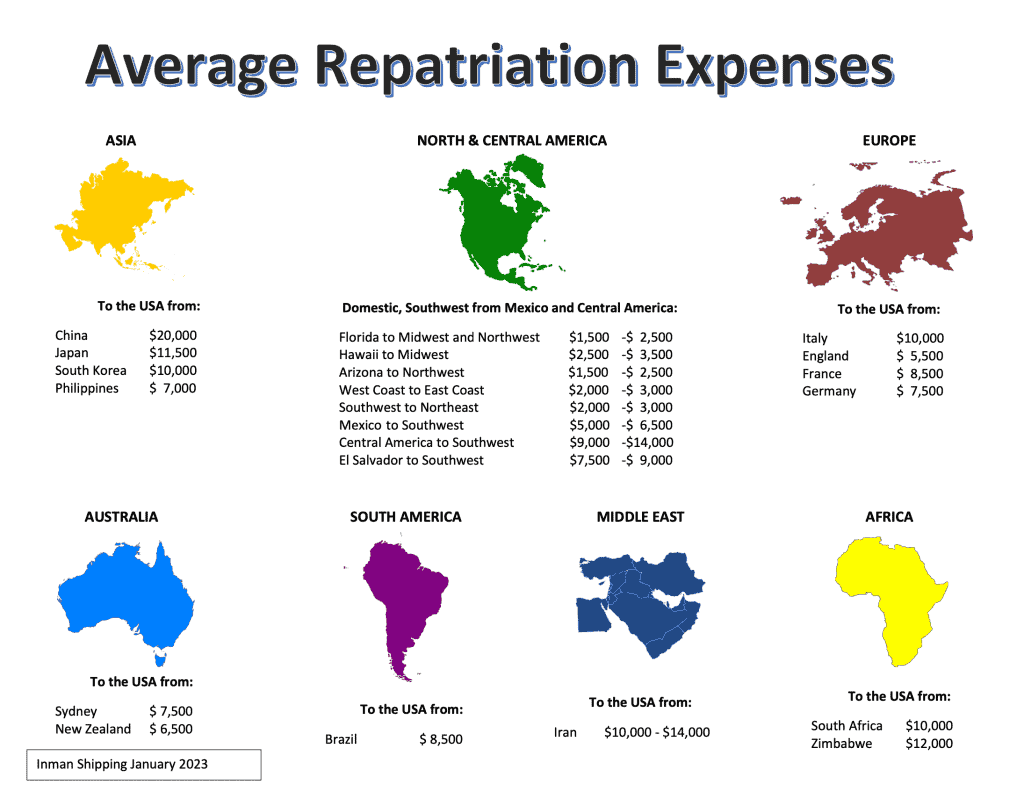
These are the numbers a plan is protecting you against. Domestic mortuary shipping commonly runs from around $3,000 to $5,000 once you add the funeral home at the place of death, preparation, a transport container, documentation, airline fees and the receiving funeral home at the other end. International repatriation regularly exceeds $10,000, and complex cases have reached $20,000 or more.
Five questions to ask before you enroll
- Is this insurance, or a service contract? If it’s a service contract, ask where the money goes and who guarantees the claim years from now.
- What is the exact distance trigger, and is it measured from my legal residence? Get the answer in writing if you split the year between two states.
- Is there a cap on transport costs, or a limit on consecutive days away?
- What happens if my family arranges transport before calling you? On most plans, the answer is that nothing is reimbursed.
- Does the plan follow me if I move? Most do, but you must update your registered address — the plan returns you to the address on file.
Who these plans genuinely suit
- Snowbirds and RV travelers spending months at a time hundreds of miles from home — the pattern travel insurance handles worst and prices highest.
- Older travelers priced out of, or excluded from, conventional travel insurance. No age limit and no health questions is the decisive advantage here.
- Families split across countries, where a death abroad means consular paperwork, translation and export permits on top of the cost.
- Anyone who has already prepaid a funeral locally — the plan is the missing piece that gets you to the funeral you’ve already arranged.
Who probably doesn’t need one
- People who rarely travel beyond 75 miles from home.
- Anyone with employer travel assistance who is not close to retirement — though it’s worth planning for the day that coverage stops.
- Households with enough liquidity to absorb a $5,000–$15,000 shock without difficulty. This is a convenience and logistics purchase as much as a financial one, and that’s a legitimate reason to buy it or skip it.
The DFS Travel Protection Plan
Lifetime worldwide coverage from the Travel Plan by Inman network, available direct. One-time enrollment of $450 per person, or $875 for a couple. No renewals, no age limits, no health questions.
See plan details and enrollUS Funerals Online is affiliated with DFS Memorials. We’ve set out the alternatives above so you can compare on the merits.
Frequently asked questions
Is a funeral travel protection plan the same as travel insurance?
No. Travel insurance is a regulated insurance policy covering trip cancellation, delays, baggage and emergency medical care for a defined trip. A funeral travel protection plan is usually a service agreement that covers one thing for life: the cost and coordination of returning your remains home if you die 75 or more miles from your legal residence. It pays no medical bills and covers no trip costs. Many travelers reasonably hold both.
What does “75 miles from home” actually mean?
Coverage begins when death occurs 75 miles or more from your registered legal residence — the address on your plan, not the address you departed from. Providers commonly measure it as a mapped road or straight-line distance. Snowbirds, RV travelers and anyone with two addresses should confirm in writing which address governs the plan, because it determines both whether the plan pays and where you are returned to.
Does it cover international travel?
Yes. All the mainstream plans provide worldwide coverage, including consular documentation, export permits, preparation for transport and airline arrangements. International repatriation is where these plans deliver most value, since the paperwork and cost are substantially higher than a domestic transfer and the U.S. government contributes nothing toward it.
Is there an age limit or a health questionnaire?
The major plans have neither. There is no upper age limit, no medical underwriting and no health questions, and coverage generally begins immediately at enrollment. This is the clearest structural advantage these plans hold over travel insurance for older travelers.
Does the plan cover the funeral itself?
No. It covers the journey home and the services required to make that journey possible — the local funeral home at the place of death, preparation, a transport container, documentation including one death certificate, and transfer into the care of your chosen funeral home. The funeral, cremation or burial that follows is separate and paid for in the usual way, whether from a preneed plan, insurance or family funds.
What if my family arranges the transport themselves?
They will generally not be reimbursed. These are service plans, not reimbursement policies: the provider must make every arrangement for the plan to apply. Carry your membership card when you travel and make sure your next of kin knows the plan exists and where to find the 24-hour number. A plan nobody knows about is a plan that doesn’t work.
Can I buy a plan as a gift for my parents?
Yes. Plans can be purchased for another person, and enrollment forms typically allow a separate mailing address alongside the participant’s legal U.S. address so the documents reach you while the coverage attaches to them. Make sure the participant’s legal residence is recorded correctly, since that address determines where they would be returned.
Will a plan satisfy a long-stay visa’s repatriation requirement?
Sometimes, but never assume it. Several countries — France among them — require documented repatriation coverage for a long-stay visa, and the specific wording they will accept varies. You will receive plan documentation and membership cards you can submit, but check the exact requirement with whoever processes your visa application before relying on a plan to satisfy it. Some consulates specifically require an insurance policy, which most travel protection plans are not.
I already have a preneed funeral plan. Do I need to tell my funeral home?
Yes, it’s worth doing. A travel protection plan is designed to sit alongside pre-arrangements you’ve already made locally: the provider returns you home, then coordinates with the funeral home holding your arrangements to transfer you into their care. Telling that funeral home in advance — and giving your family the plan number — removes friction at the worst possible moment.
What happens to my money between enrolling and dying?
This is the question too few buyers ask. Because most travel plans are not insurance, the provider is not legally required to hold your payment in a reserve or trust, and a buyer in their fifties may not claim for forty years. The stronger arrangements in this market are backed either by an insurance reserve or by a contractual liability insurance policy that guarantees each individual claim. Ask which applies before you enroll.
Related guides

Sara Marsden-Ille
Funeral industry researcher · Editor, US Funerals Online
Researching and writing about the U.S. death care industry for over fifteen years, with a focus on funeral pricing transparency, cremation, and the laws governing funeral practice. Co-founder of DFS Memorials. Independent funeral consumer guidance since 2003.


