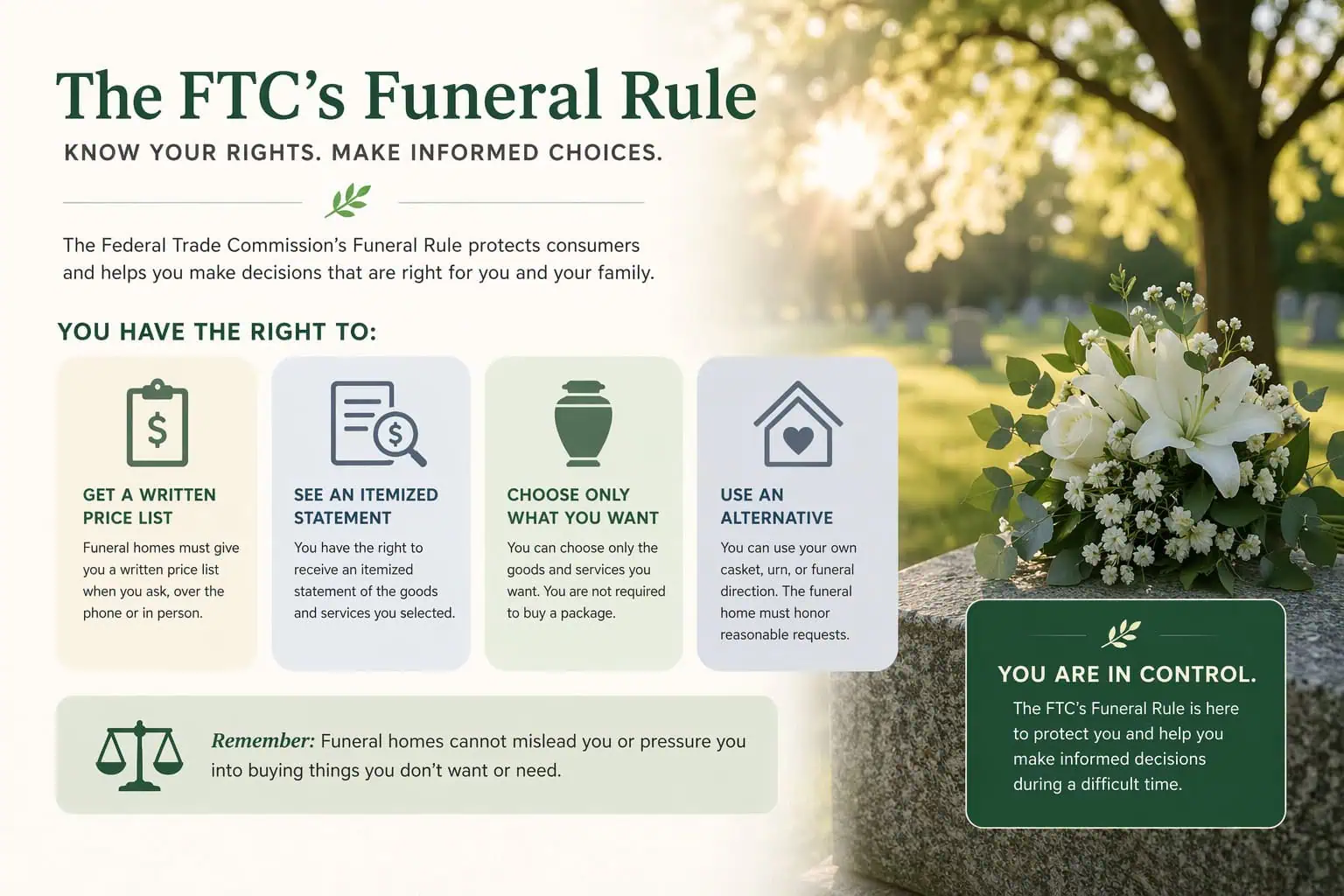
The Federal Trade Commission (FTC) Funeral Rule is the single most important federal consumer protection law for anyone arranging a funeral or cremation in the United States. It requires funeral providers to give you accurate, itemized price information, prohibits them from bundling services you don’t want, and gives you the right to buy only what you choose.
Yet, despite being on the books since 1984, recent FTC enforcement actions reveal that compliance remains inconsistent — and many families only discover their rights after being overcharged. This guide explains exactly what the Funeral Rule is, the ten specific rights it gives you, what it does not cover, and what to do if a funeral home violates it.
What is the FTC Funeral Rule?
The Funeral Rule (formally, the Funeral Industry Practices Rule, 16 CFR Part 453) is a federal trade regulation enforced by the Federal Trade Commission. It applies to every funeral provider in the United States that sells both funeral goods and funeral services to the public — including funeral homes, cremation providers, and some cemeteries and crematories that market both goods and services.
At its core, the Rule exists to do two things:
- Guarantee price transparency so that families making funeral arrangements — often under emotional strain and on short timeframes — can obtain accurate, itemized prices and compare providers.
- Prohibit deceptive and coercive sales practices, such as misrepresenting what the law requires, bundling mandatory packages, or refusing to accept outside caskets.
The Rule took effect on April 30, 1984, and was substantially amended in 1994. The FTC reviewed the Rule again in 2020 and, in October 2022, determined that it continues to serve a useful purpose and should be retained. A separate proceeding to consider potential amendments — most notably a mandatory online pricing requirement — remains open but has not resulted in any changes to the Rule as of 2026.
Why the Funeral Rule exists
Before 1984, the funeral industry operated with almost no federal oversight. Investigations conducted by the FTC in the late 1970s and early 1980s documented widespread practices that would be illegal today: families being told embalming was legally required when it wasn’t, funeral homes refusing to itemize prices, packaged funerals that forced consumers to buy goods they didn’t want, and a near-monopoly on casket sales that kept prices artificially high.
The Funeral Rule dismantled most of those practices by codifying specific consumer rights and requiring detailed, written disclosures. It has been upheld twice in federal appeals court (by the Fourth Circuit in 1984 and the Third Circuit in 1994).
Your 10 Rights Under the Funeral Rule 📜
The following ten rights are the practical core of the Funeral Rule. Every one of them is federal law — not a courtesy, not a policy, not something a funeral home can waive or negotiate.
1. The right to buy only what you want. You can choose individual goods and services à la carte. A funeral home cannot require you to buy a package as a condition of providing any single item or service — with one narrow exception: the non-declinable “basic services fee” that every funeral home is permitted to charge (and which must be clearly disclosed on the General Price List).
2. The right to get prices over the phone. If you call a funeral home to ask about pricing, they must provide the information. You do not have to provide your name, address, or any personal information to receive it. This right extends to specific itemized prices — not just package totals.
If a funeral home is reluctant to disclose funeral prices over the phone ~ this should generally be a indicator that they are not openly transparent about pricing.
3. The right to a written, itemized General Price List (GPL). When you inquire in person about funeral arrangements, the funeral home must give you a printed General Price List to keep. The GPL must itemize prices for every good and service the funeral home offers.
4. The right to a separate Casket Price List (CPL). Before showing you any caskets, the funeral home must provide a written casket price list. This may be a standalone document or incorporated into the GPL. If the funeral home sells outer burial containers, it must also provide a separate price list for those containers.
5. The right to buy a casket or urn elsewhere. You can purchase a casket or cremation urn from any third-party seller — a retail casket company, an online provider, Costco, or anywhere else — and the funeral home must accept it. They cannot charge a handling fee, require you to be present for the delivery, or refuse to use it.
Important state-law exception: A small number of states have laws giving licensed funeral establishments an exclusive right to sell caskets. These restrictions have historically applied in states including Alabama, Louisiana, Mississippi, and Virginia, though the legal landscape has shifted over the years. Your right to use a third-party casket at any funeral home is still protected by federal law everywhere in the U.S. — the state-law question is only about who can sell one to you.
6. The right to refuse embalming. No state in the U.S. requires embalming by law when the burial or cremation will take place promptly. Refrigeration is an accepted alternative everywhere. A funeral home may have its own policy requiring embalming for public open-casket viewings, but they must tell you in writing that embalming is not legally required in most circumstances, and they cannot charge you for embalming you did not authorize.
7. The right to use an alternative container for cremation. No state law requires a casket for cremation. The Funeral Rule specifically protects your right to use an inexpensive, unfinished wood or cardboard “alternative container” instead.
8. The right to an itemized Statement of Funeral Goods and Services Selected. Before you pay, the funeral home must give you a written, signed itemized statement listing every good and service you have agreed to purchase, along with the individual price for each and a total. This is your contract. Read it carefully before signing.
9. The right to accurate information about legal requirements. A funeral home cannot misrepresent what state or local law requires. If they claim that a particular good or service is legally mandatory (embalming, a specific type of casket, an outer burial container), they must be able to cite the specific law, and it must appear on the Statement of Funeral Goods and Services Selected.
10. The right to disclosure of cash-advance items. If the funeral home is purchasing items on your behalf from third parties (clergy honoraria, flowers, obituary notices, musicians), these are “cash advance items.” If the funeral home receives a commission, discount, or rebate for these items, it must disclose that fact in writing.
The General Price List (GPL) Explained
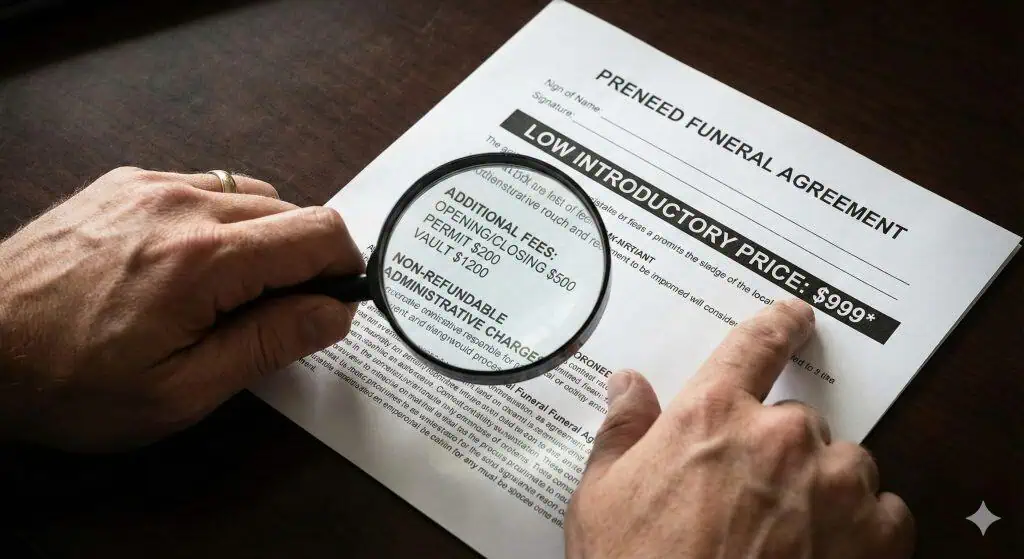
The General Price List is the foundational document of the Funeral Rule. It is the written, itemized price sheet every funeral home must provide to anyone who inquires in person about funeral arrangements. You are entitled to keep your copy.
A compliant GPL must include the funeral home’s name, address, and telephone number, an effective date, and specific required disclosures — including your right to choose only the goods and services you want, and the disclosure that embalming is not required by law in most cases.
The GPL must itemize prices for the following categories of goods and services (when the funeral home offers them):
- Forwarding of remains to another funeral home
- Receiving remains from another funeral home
- Direct cremation
- Immediate burial
- Transfer of remains to the funeral home
- Embalming
- Other preparation of the body
- Use of facilities and staff for viewing
- Use of facilities and staff for the funeral ceremony
- Use of facilities and staff for the memorial service
- Use of equipment and staff for a graveside service
- Hearse
- Limousine
- Other automotive equipment
- Caskets (or cross-reference to the separate Casket Price List)
- Outer burial containers (or cross-reference to the separate OBC Price List)
- The basic services fee (the only non-declinable fee the Rule allows)
The basic services fee covers the funeral home’s overhead and the services of the funeral director and staff that apply regardless of which arrangements a family chooses. It is non-declinable — meaning you cannot opt out of it — but it is the only overhead fee the Rule permits. A funeral home cannot tack on a second non-declinable charge (a “facilities fee,” a “casket handling fee,” an “administrative fee”) on top of the basic services fee.
For a more detailed walkthrough of how to read and compare GPLs, see our Glossary of Funeral Terms: How to Understand the General Price List.
What the Funeral Rule Does NOT Cover ❌
Understanding the limits of the Funeral Rule is just as important as understanding what it protects. Several significant gaps exist that consumers are frequently caught by:
Cemeteries (in most cases). The Funeral Rule generally does not apply to cemeteries unless the cemetery also sells funeral services. A cemetery selling only burial plots, monuments, and interment services is not covered. This means cemetery price disclosures, plot contracts, and maintenance fees are regulated (if at all) by state law, not by the FTC Funeral Rule. The FTC considered expanding the Rule to include cemeteries during its 2020–2022 review, but declined to do so.
Third-party crematory fees. If your funeral home uses an outside crematory and passes the crematory’s fee on to you as a cash advance item, the Rule does not currently require that third-party fee to be disclosed line-by-line on the GPL. This is one of the specific issues the FTC has flagged for possible future amendment.
Pre-need and pre-paid funeral contracts. The Funeral Rule governs the transaction at the time of need. Pre-need funeral contracts — where you pay for a funeral in advance of death — are regulated almost entirely by state law, and the protections vary dramatically from state to state. For a worked example, see our guide to cancelling or transferring a Neptune Society plan.
Online price disclosure. As of 2026, the Funeral Rule does not require funeral homes to display prices on their websites. The Rule requires prices to be available on request, in person or by phone — but not online. This remains the most actively debated potential amendment to the Rule, and it is the single biggest gap between what the Rule requires and what today’s consumers expect.
See our post on why so many funeral homes don’t display prices on their websites for more on this and why the largest funeral and cremation brands still publish no prices online.
State-law casket sales restrictions. As noted above, a small number of states restrict who can sell caskets. The Funeral Rule does not override those state laws, though it does guarantee your right to use a third-party casket at any funeral home nationwide.
How the FTC Enforces the Funeral Rule
The FTC enforces the Funeral Rule through a combination of consumer complaints, compliance reviews, undercover inspections, and formal enforcement actions. Civil penalties for violations can reach up to $53,088 per violation (adjusted annually for inflation under federal law).
The Funeral Rule Offenders Program (FROP)
Funeral homes found to have violated the Rule — particularly on price disclosure requirements — are typically offered a choice: face a federal enforcement action seeking civil penalties, or enroll in the Funeral Rule Offenders Program (FROP). FROP is a compliance training program administered by the National Funeral Directors Association (NFDA) on behalf of the FTC.
Participating funeral homes agree to:
- Make a voluntary payment to the U.S. Treasury in lieu of a civil penalty (historically calculated as a percentage of annual gross revenue)
- Pay annual administrative fees to the NFDA
- Submit to legal review of their price disclosures
- Undergo ongoing training, testing, and monitoring for the duration of the program (typically three to five years)
Since FROP launched in 1996, the FTC has inspected thousands of funeral homes through the program and its associated inspection sweeps.
The 2023 undercover phone sweep
In 2023, the FTC conducted its first-ever undercover Funeral Rule phone sweep. Between February and December 2023, FTC staff posed as consumers and placed calls to 278 randomly selected funeral providers across the country, requesting pricing for services including direct cremation, cremation with a memorial service, and cremation with a viewing.
The results, published in a November 2024 staff report, revealed significant compliance problems:
- 39 funeral homes received warning letters for failing to provide price information in compliance with the Rule
- Nearly 70% of providers called outside business hours required multiple calls or a callback to obtain pricing
- About 30% of providers called during business hours required multiple attempts
- Half of the providers answered at least some pricing questions with estimates or ranges rather than specific prices
- At least 33% provided package pricing without offering itemized prices
- At least 37 providers quoted different prices for the same service on different calls
These findings underscore something families arranging a funeral already sense: getting accurate, comparable pricing from funeral homes remains harder than it should be — even when federal law says it shouldn’t be.
Status of the Funeral Rule in 2026
After years of review, workshops, and public comment, the current status of the Funeral Rule is straightforward but important to understand:
- The Rule remains in force in its 1994-amended form. The FTC determined in 2022 that the Rule continues to serve a useful purpose and should be retained.
- No amendments have been finalized. The FTC opened an Advance Notice of Proposed Rulemaking (ANPR) in November 2022 and held a public workshop in September 2023 to explore potential updates, including mandatory online price disclosure. As of 2026, that rulemaking process has not produced any final changes to the Rule.
- The next routine regulatory review is expected in the 2030 timeframe, though the ANPR-based amendment process remains technically open and could produce changes sooner if the FTC chooses to move forward.
The seven issues the FTC has formally considered for possible amendment are:
- Electronic (online) price disclosure
- Disclosure of third-party crematory fees on the GPL
- Limited exceptions to the basic services fee
- Disclosures for new forms of disposition (alkaline hydrolysis, natural organic reduction)
- Amendment of the mandatory embalming disclosure
- Improvement of GPL readability
- Effects on historically underserved communities
For a deeper look at the proposed amendments and the debate around them, see our analysis of the FTC’s proposed changes to the 40-year-old Funeral Rule.
How to File a Complaint Against a Funeral Home
If you believe a funeral home has violated the Funeral Rule, you have several avenues of recourse. Using more than one simultaneously is often the most effective approach.
Step 1: Try to resolve it with the funeral home directly. Many Funeral Rule disputes can be resolved at this level, particularly once you make clear that you understand the Rule and are prepared to escalate. Put your complaint in writing, reference the specific provision of the Rule you believe was violated, and keep copies of all documents (the GPL, the Statement of Funeral Goods and Services Selected, any receipts, and any written communications).
Step 2: File a complaint with the FTC. The FTC does not litigate individual consumer disputes, but every complaint it receives contributes to its enforcement priorities and its identification of problem funeral providers. File your complaint at ReportFraud.ftc.gov — the FTC’s main consumer complaint portal — and select the funeral category.
Step 3: Contact your state funeral licensing board. Every state has a licensing board that regulates funeral establishments and funeral directors. State boards have enforcement authority that the FTC does not: they can suspend licenses, impose fines, and require corrective action. State-specific guidance on contacting your licensing board is in our state funeral planning guides.
Step 4: Contact the Funeral Consumers Alliance (FCA). The Funeral Consumers Alliance is a national nonprofit consumer advocacy organization with local affiliate groups in many states. FCA can provide guidance, connect you with resources, and, in some cases, intervene on your behalf.
Step 5: Contact your state attorney general’s consumer protection division. If the violation involves significant financial harm, fraud, or deceptive practices, your state AG’s office may be able to take action.
Frequently Asked Questions
Yes. The Funeral Rule is federal law and applies to all funeral providers in the United States — regardless of whether the state has its own additional funeral regulations. Where state law provides stronger consumer protections, state law applies on top of the federal Rule. The Funeral Rule establishes a floor of consumer rights, not a ceiling.
No. Embalming is not required by law in any U.S. state when burial or cremation will occur promptly. A funeral home may have its own policy requiring embalming for a public open-casket viewing, but they cannot tell you it is legally required, and they cannot charge you for embalming you did not authorize in writing.
Yes. The Funeral Rule specifically protects your right to buy a casket or urn from any third party, and the funeral home must accept it without charging a handling fee or requiring you to be present for delivery. A small number of states restrict who may sell caskets, but your right to use a third-party casket at any funeral home is protected by federal law everywhere.
As of 2026, civil penalties for Funeral Rule violations can reach up to $53,088 per violation. This figure is adjusted annually for inflation. In practice, most first-time violators are offered the opportunity to enroll in the Funeral Rule Offenders Program (FROP) rather than face a full enforcement action.
Generally, no. The Rule applies only to providers that sell both funeral goods and funeral services. A cemetery selling only burial plots, monuments, and interment services is not covered. Cemeteries that also sell funeral services are covered for that portion of their business. Cemetery practices are otherwise regulated by state law.
No. As of 2026, the Rule requires funeral homes to provide price information in person and over the phone, but not on their websites. Online price disclosure is the single most-discussed potential amendment to the Rule, and FTC staff research has documented that most funeral home websites still do not display pricing. Until the Rule is amended, you may need to call or visit in person to get accurate prices.
First, confirm you’re asking for what the Rule covers: pricing for specific goods and services. You do not have to provide your name or personal information. If the funeral home still refuses, thank them, hang up, and choose a different provider — then file a complaint at ReportFraud.ftc.gov. Refusing to provide telephone pricing is a direct Funeral Rule violation, and it is exactly the conduct the FTC’s 2023 phone sweep targeted.
Related Resources
From US Funerals Online:
- State Funeral Planning Guides
- Glossary of Funeral Terms: How to Understand the General Price List
- A Guide to Buying a Casket
- Why Do So Many Funeral Homes Not Display Prices on Their Websites?
- America’s Most Bizarre Funeral Rules
- The FTC’s Proposed Changes to the Funeral Rule
External authoritative sources:
- Federal Trade Commission — Funeral Rule
- FTC — Complying with the Funeral Rule (full text)
- FTC ReportFraud portal
- Funeral Consumers Alliance (FCA)
- National Funeral Directors Association (NFDA)
Last updated: July 2026. This article reflects the status of the FTC Funeral Rule as of 2026. The Funeral Rule is an active area of federal rulemaking; we update this page when the FTC takes formal action.


